A beekeeper in Akron, Ohio wrote and asked about our business model and said that he was interested in doing something similar in his city. I realized as I wrote my reply that my husband and I had learned a lot about city beekeeping in the few years that we have been involved. My reply to that beekeeper is below.
Dear ******,
I am glad to hear that you are interested in city beekeeping. We have 35 hives in about 10 locations including 2 nearby farms. We have found that the amount of driving involved really cuts into our profits. It is difficult to break even. I would suggest that you concentrate on one area of your city for beehives. It also helps if you can keep 4 to 10 hives in any one location. Check with city ordinances for the number of hives that can be kept in any single location.
Security is a prime concern on vacant lots. You will need some kind of protection from vandalism like a big cyclone fence or video surveillance. Swarms are a neighborhood event and can be very scary for those who do not know what is happening. Neighborhood education can really help with that.
Be really careful about selecting a queen breeder. Aggressiveness in bees is a genetic issue and the queen source can make a big difference. Don't get bees from Texas. Use a trusted source. You want gentle bees in the city. Re-queen any hives that show highly aggressive tendencies.
Before you get lots of hives, consider how you will market your honey. When we got 4 hives, we suddenly had far more honey than we knew what to do with. At that point, we started selling honey once a week at a local farmers' market. You could do that or you could sell from your front yard if the city allows it or you could market to local organic type groceries. We like the direct contact with customers and the profits we can get from direct sales. All our honey sells rapidly and we usually sell out before Christmas.
We use a 6 frame radial extractor from Maxant (based in Massachusetts) with a motor drive. This small extractor keeps up ok for now. We use a hot knife to uncap the frames. We bottle by hand from food grade plastic buckets with a honey gate. If you do not have an extractor, check with your local beekeeping club. They may have one you can rent.
We have kept bees for about 6 years. We started when our daughter studied bees for a college course and she thought we might like the hobby. We started selling honey 5 years ago. Our business really started taking off last summer when we found people coming to our small farmers' market just for our honey. We do not make a whole lot of money at this because the expenses are too great but we have a whole lot of fun and meet some great people.
Showing posts with label urban honey. Show all posts
Showing posts with label urban honey. Show all posts
Thursday, October 3, 2013


Friday, December 7, 2012
Bee Log #83
I have been making homemade lip balm, lotion bars and mustache wax from the beeswax that I recover after extracting honey.
Thursday, September 23, 2010
Bee Log 48: September 23, 2010

The plastic construction is our dehumidification chamber. Also in the picture are our new honey extractor and boxes of jars for honey. I think we need to rethink the design(?) of our dehumidification space.
This is the first official day of autumn. This year it really feels like fall. It has been so cool and rainy in Seattle. Our bees continue to struggle to get enough nectar to store a surplus for us to take and sell. The last honey that we took seemed sort of runny so we bought a refractometer to check the water concentration. Honey might ferment if the water percentage is higher than 18.5%. Our honey had a water concentration of 19%.
What do we do with runny honey? We purchased a dehumidifier and some heavy plastic sheeting. We used the plastic sheeting and a desk to make a little room in which to put the dehumidifier and the honey in an uncovered bucket. It took less than 12 hours to dehumidify the honey to about 18%. The operation produced a bit of heat that built up in the plastic room. We did not feel comfortable running the dehumidifier when we were not home or when we were sleeping. I would guess that the temperature generated was in the high 90's so it was not overly dangerous. It was hot enough to cause us to be vigilant.
We are starting the process of preparing the hives for the fall. The supers (boxes where the bees store excess honey) come off the hives and most of the hives will get fed sugar water. We are very busy with our day jobs (teaching), the farmers' market and the bee chores.
Tuesday, August 10, 2010
Bee Log 45: August 10, 2010

At last we have honey to sell at the Phinney Farmers' Market on Friday nights from 3 to 7pm. Look for us there.

My husband uncapping a frame of honey. Note the dark honey in the center of the frame. The bees were collecting from two different flowers.

The extractor with a frame of honey inside.

The garden is producing despite the cold summer that we have had in Seattle. Shown is an orange cauliflower.
Six year old Belle wants to be a beekeeper. Her parents brought her over to our house to look at the beehives. The bees were a bit scary but that did not deter her interest. I have to admit that I am a little afraid of the bees too. One should respect a stinging insect with a powerful venom inserted with a barbed needle connected to a pumping device.
All of our bee suits were all hopelessly too big for tiny Belle. It was raining so we had a really good excuse not to look inside a live hive. We did watch the bees at the entrance of the hive for awhile. We also looked at an empty hive with frames inside and at our honey extractor.
I hope that this interest in bees will grow into a lifelong hobby or business. One never knows with a 6 year old. One must be careful not to discourage good things because of youth.
Thursday, July 1, 2010
Bee Log 43; July 1, 2010
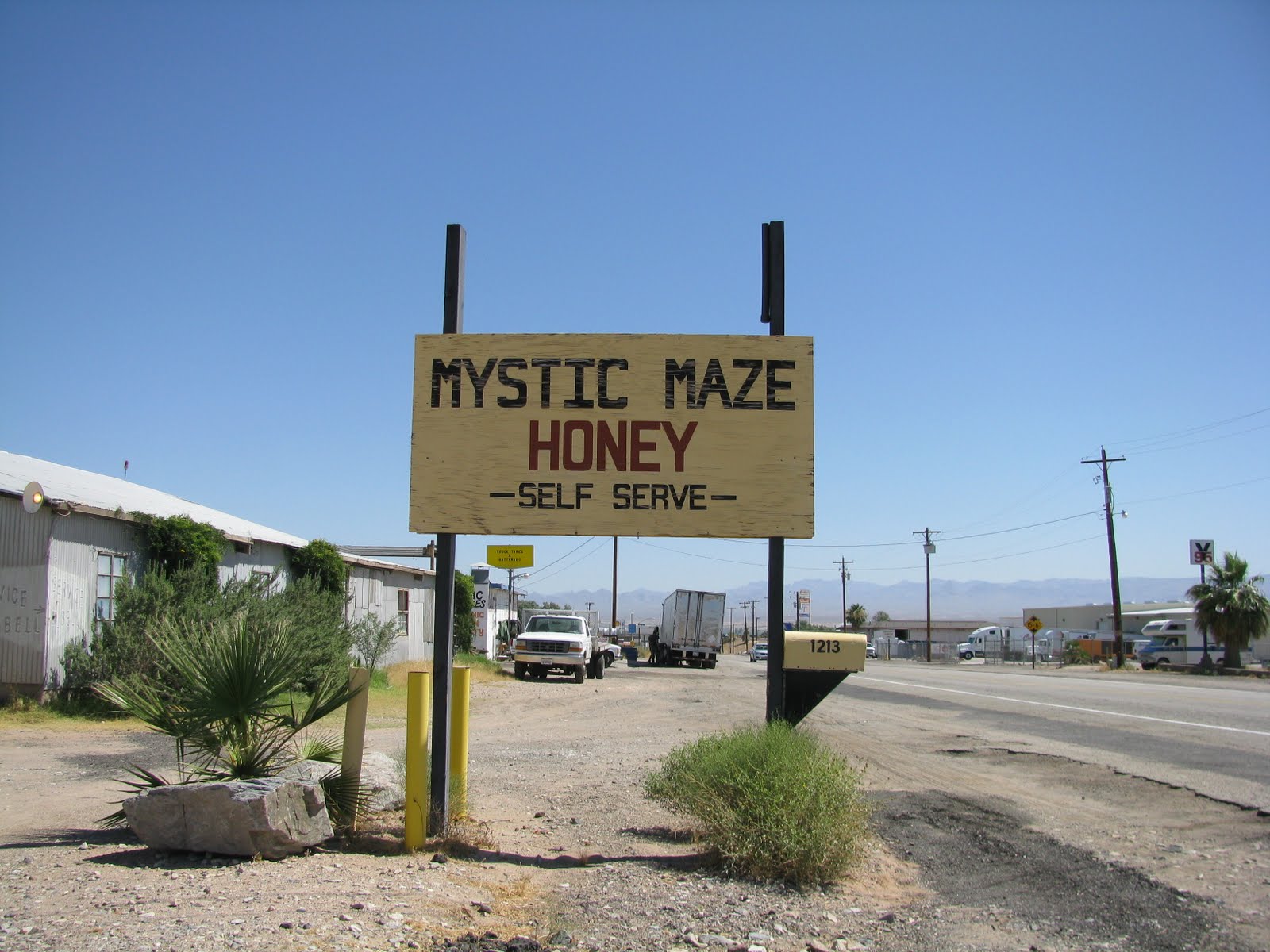
In mid-June, we drove from Chicago to Los Angeles with our daughter who was moving from the mid-west. We stopped and bought honey from Mystic Maze Honey located in Needles, CA.

Honey was sold on the honor system out of this trailer.

This coyote was walking along just across the road from the honey sales trailer.

Our bees about June 10.
We do not have any honey to take from the bees yet. We will not be at the Phinney Farmers' Market on July 2. We hope to have honey to harvest for the July 9 market. Only two hives our of our 19 hives have some capped honey in the supers. When the bees are finished dehydrating the nectar that they have collected, they cap it with a thin coat of wax. This protects and preserves the honey. This is our signal that the honey is ready to harvest. The super is a box on top of the beehive meant for surplus honey storage. We only take honey from the super leaving any honey in the brood box for the bees.
This cold, wet weather we are having in Seattle is hard on the bees. We have had swarms but the new queens have not had warm enough weather to mate (70 degrees needed). We have purchased mated queens and placed them where needed.
The main nectar flows in western Washington are big leaf maple and blackberry. Maple is long gone and blackberry is blooming right now. Lavender will be next in our area of Seattle along with many garden herbs. Watch to see what the honey bees are visiting in your yard. Let me know what you see.
Wednesday, March 17, 2010
Wallingfor Urban Honey becomes Seattle Urban Honey
We are changing the name of Wallingford Urban Honey to Seattle Urban Honey to reflect the fact that our hives are now going to be located throughout the Seattle metropolitan area. Thanks for your interest in this project. Look for us at the Phinney Farmers' Market.
Tuesday, February 2, 2010
Bee Log #10: February 2, 2010


The above pictures were taken at the Washington Park Arboretum January 15, 2010. The building shown is the Graham Visitors' Center, meeting place of the Puget Sound Beekeepers' Association.
I am happy to report that we have recruited 5 homeowners located in north Seattle that are very interested in having bees placed in their yards. Thank you to those homeowners. We are hoping to promote bees as a wonderful hobby that can be pursued by the average person and to increase our honey harvest.
My husband and I will be placing 2 hives each on 4 of these properties and one hive on the remaining property. We have ordered 8 packages of bees and will use one hive from our current stock. This is as big as we wish to get this summer. It is important that we not expand beyond our capacity to manage our bees since they are placed in an urban environment. All of the bee-placement homeowners are very enthusiastic and I aim to keep it that way! They are hosts of living creatures and we are responsible for the care of those creatures.
We have decided to use western size brood boxes with plastic frames for the interior. The western boxes are 6 1/4 inches high and much lighter than the standard deep box especially when full of honey and brood. The plastic frames come as one piece and don't require assembly or wiring. We also won't have problems with broken wires or frames coming unglued when we try to pull them out of the hive. The bees are said to do fine on the plastic.
I have gotten my apprentice beekeeper certificate through the Puget Sound Beekeepers' Association. My husband is currently studying for the required test.
The weather has been unseasonably warm (a record for January in Seattle). The bees have had opportunities to fly for a few hours each day. They are bringing in pollen of several colors! Many plants are blooming including the earliest plums and crocuses. One of our hives is especially active. Another hive is showing little activity (I know it is still alive and has sufficient stores of honey). We will see what this means for those hives later on. I do not have enough experience to do more than guess. I will wait for a few weeks to do an inspection of the interior of the hives as it not warm enough to risk chilling any baby bees (brood). Warm is a relative term in Seattle! The temperature has been in the low 50's rather than the usual mid 40's.
We are hoping to return to the Phinney Farmers' Market in early July. With more hives, we should be better able to keep up with the demand for local raw honey.
Subscribe to:
Posts (Atom)
