Showing posts with label Swarm. Show all posts
Sunday, July 1, 2012
Bee Log #74
We had another swarm this past week. This swarm was a little tricky to get because of the structure of the grape arbor that it landed on. We ended up brushing them into a bucket and then dumping the bees into a waiting hive. We got the queen on the first try. We knew we had her because in about 10 to 15 minutes after we put the bees into the hive, a bunch of bees start to fan at every entrance to the hive. The bees have a scent that they broadcast from their Nasenov gland by putting their rear ends up in the air and fanning their wings to tell the bees on the outside of the hive the location of the queen. Pretty soon the air was filled with bees leaving the swarm site headed for the hive. The hive sat on our picnic table until we could move the bees to an apiary that we have recently established in Carnation, Washington (about 25 east of Seattle).
This makes 19 swarms that we have caught this year. Most of these swarms have a pretty good chance to build up enough strength and stores to make it through next winter.
Friday, June 22, 2012
Bee Log #72

We had another swarm yesterday, the 18th of the year. It was about 10 feet up in an alder tree and very accessible (unlike one that we got out of a blackberry thicket earlier in the week). The order of the pictures seems to be out of my control. The first picture is dumping the bees into a waiting hive, the second picture is the swarm in the tree before we touched it and the third is placing the bucket under the bee swarm just prior to bumping the branch to get the bees into the bucket. I am hoping that the blogger program is again allowing me to separate paragraphs with the enter button.
We will be at the Phinney Farmers' market today, Friday, June 22, from 3 to 7 pm.
Saturday, June 9, 2012
bee log # 69
What is the state of the hives this summer? Booming. We have captured 15 swarms and have started a new apiary on a farm near Carnation, Washington. If we can just convince the farmer to move his burn barrel a little further from the hives, I think we can get a load of honey and help the near-by vegetable farmers at the same time. It has been warm and sunny just enough for the bees to get out and forage. The black locust trees are blooming right now and the blackberry is just about to come out. The Carnation farmer reported that the bees were all over his locust tree. I have included a few more images of the large swarm that we caught.
Here you can see the bees fanning to let the other bees know where the queen is.
Monday, May 21, 2012
Bee Log #68
Flat Stanley came to Seattle from a young relative in Pennsylvania. He got to visit a bee swarm when he was here.
We were just delighted to get into our hives in late March and find that most of them had survived. This is a good looking bunch of bees ready to go after the first pollen and nectar that they can find.
This was a huge swarm about 25 to 30 feet up in a pine tree. We got this swarm by using a 12 foot orchard ladder and a bucket taped to the end of a 20 foot aluminum painting pole. Those bees can feel pretty heavy at the end of a long pole!
We had lots and lots and lots of swarms in late April and early May this year. They were all from our own hives as far as I know. This was the weirdest swarm. It left the hive on a rainy day and landed on the edge of a garden bed.
Our happy news this year is that we lost only 4 out 24 hives last winter. The previous winter we had lost 18 of 19 hives so this was a great improvement. The big loss was probably from colony collapse. This winters losses were from running out of food.
Out hives looked really robust when we went through them in March. Some of them were making bees like crazy as we found out when they started to swarm. We currently have 34 hives. We bought 5 packages so that means that we caught 13 swarms. Twice, we caught 2 swarms in one day.
Saturday, June 11, 2011
Bee Log 59: June 11, 2011

We caught a swarm on Thursday evening. The swarm was from our own bees at the Urban Horticulture Center. I did not think of getting my camera out until we had bumped the swarm into a 5 gallon bucket and poured the bees into a waiting hive. Here the bees on the inner cover of the hive are scent fanning, rears in the air and wings going like mad, to call the rest of the bees to the hive. The queen is inside the hive and the rest of the bees in the swarm are being informed of her whereabouts.

This picture was taken about 5 to 10 minutes after the first picture. Notice that almost all the bees are aiming toward the hole in the top of the inner cover.

It takes time to hive a swarm. We spent about 45 minutes to an hour waiting for the bees to march into their new home.

Almost all the bees are in the hive now. It is time to put the cover on the hive and to place the hive where we want it. The old queen will be in the hive with the swarm. The hive where the swarm originated will be raising a new queen. She will hatch within about 5 days. The new queen will then need a 70 degree day to get out to mate.
Bees in a bird house:

This cute little bird house belongs to friends of mine, J&B. It fell out of the tree where it was hanging and B went to pick it up and was quite surprised (understatement) when bees came pouring out. In general, we do not handle bees for people other than honey bee swarms but for close friends with bees in a bird house we do make exceptions. We were in a time crunch because we needed to be at a high school graduation so my husband with his bee suit on popped the whole bird house into an empty bee hive and left the hive sitting in J&B's yard so the rest of the bees could find their home that evening. My husband described the bees as fat and fuzzy. He knew they were not honey bees but did not have time or leisure for further identification.
After the graduation, we raced back to change clothes and retrieve our hive with unidentified bees. We plugged the entrance to the hive, strapped the hive together, took it home in the back of our pickup and left it there until morning. This morning, we located a place in a tree in our yard for the little bird house, suited up and placed the bird house in the tree.
The bees are a small bumble bee. I am glad that we saved them because we need native pollinators as well as the honey bees. I will try to get a picture of one of the bumble bees.
Wednesday, May 19, 2010
Bee Log 39; May 19, 2010

Swarm Capture Bucket

Beehive with Swarm
I captured a swarm today. No, this video is NOT me. It was my inspiration and what I wish I had looked like. Thank you Jeff McMullan for your excellent footage of a very experienced beekeeper.
I had seen this video on Youtube and had a similar situation developing at my house. The bees landed in a pear tree on the alley about 4 houses down the block. I was home alone so it was up to me or wait. Bad weather was forecast so I chose to act. I taped a 5 gallon paint bucket to the bottom of a 12 foot pruning pole with duct tape (see photo). I prepared a box to receive the bees complete with bottom and top. I practiced getting near the swarm but not hitting them. I practiced dumping the bees in the box from the ladder. I prayed and then I bumped the bucket as hard as I could up under the swarm. I did not anticipate the weight of the swarm. I must have had 5 pounds of bees. It took me a few seconds to readjust to the weight and get the bees safely out of the tree. I dumped the bees in the waiting hive and put the lid on askew and sat down to wait (see photo). There were still a significant number of bees in the tree. I was worried that I did not get the queen. I waited. The bees started fanning at all open points on the hive. Bees started filling the air. I could not tell if the bees were headed out or in the hive. I waited. The bees were going in!
About this time I talked to a neighbor, Tony, who was taking out his garbage. I explained what was happening as there were still a lot of bees in the air. It is a bit alarming to see a swarm.
I waited for about an hour until most of the bees were in the hive. Then, I put a strap around the hive and pulled it home on a dolly. I hope they like their new home!
Tuesday, April 20, 2010
Bee Log 30: April 20, 2010


The queen-less hive that has been swarming out and then in each day for the last week or so finally swarmed out and stayed out. I was grateful that the swarm landed in our yard on nice low raspberry bushes. I clipped a few canes so that I could get the majority of the swarm on top of a new hive body. The bees started to melt down in between the frames. As bees moved into the hive from the top, a troop set up a fanning action on the front of the hive. They are the bees on the front of the hive with their back ends in the air waving their wings like crazy. The function of this is to disperse a pheromone telling the other bees that they want to set up house-keeping here. Notice all the bees on the ground aiming in the direction of the hive. They are being called into the hive and have started marching in that direction. Eventually most of the bees made it into the hive and we put a lid on the box.
After night-fall, we wanted to put the hive in a more convenient location. There was still a beard of bees hanging off the front deck of the hive. My husband got a bit impatient and was grabbing handfuls of those bees and trying to stuff them through their front door. Needless to say, this was not popular in beeville. Good thing we had on our bee suits. We left them for the night and moved the hive the next morning while it was still too cool for the bees to fly.
The big question is the queen. I had put the queen cell pictured in the last post in the queen-less, swarming hive to try to get the bees to hang on until we were able to requeen that hive. I don't know if that cell opened on its own or was torn apart and destroyed. The left over queen cup had the appearance of the latter. So, the possibilities for both hives are no queen or an unmated queen.
I purchased two mated queens from Beez Neez (Snohomish, WA) last Friday, April 16. The queens and attendants were in boxes about the size of a box that comes with a nice pen set. The end of the box was blocked with a bit of hard candy. The candy blocked the entrance and would provide about 3 days of food and then freedom. I did not have time to answer the queen question so I suspended the two new queens in the two hives existing after the swarm. Today (Tuesday, April 20), I need to get in those hives and see what I can see.
Wednesday, April 14, 2010
Bee Log 29: April 14, 2010


Two of the above pictures are of a beautiful capped queen cell taken from one of our hives. One picture includes a pair of pliers for scale. The third picture is 12 hives assembled and ready for the bees that arrive on Saturday. The hives will be placed in 7 backyards around north Seattle.
We finally got a nice enough day that we could go through our hives and see what was going on. The hive that has been swarming out and then back in (!) each day has no queen. There are a few capped drone brood but other than that there are no eggs or brood. A drone emerges from his cell in 24 days after the egg is laid so this hive has likely been queenless for about 3 weeks. A queen is coming on Friday so hang on bees!
Another hive is normal, crowded and storing honey in the two supers on top of the hive. The third hive has lots of brood but no eggs. That is the hive that we got the queen cell from. We cut it out because it is still too cold for a new queen to get out to mate. We think that the lack of eggs means that the hive is preparing to swarm. If they can wait until Friday, we will split the hive and put a new queen in the hive without the queen. This is the hive with three deep boxes and lots of bees so we are hoping the the queen won't be hiding! Splitting means that we put half the frames with attached bees in one hive and half in another box. The trick is knowing which box has the current queen.
Friday, April 9, 2010
Bee Log 27: April 9, 2010

Me and the Bees taken April 8, 2010
I just looked in the box with the new swarm. They are gone. I know that they did not get far because it has been colder than 50 degrees since we put them in that box. I think some of them must have gone back to the original hive. I will look for a queen in the midst of the 50 to 60 bees that are left in the new box. I am not sure that you ever really get good at bees. They keep doing new stuff that is hard to figure out. It is too cold to go through the hive to check for queen cells or eggs.
Meanwhile, today we got up at 4:30 am and headed to Gladstone, Oregon to Ruhl Beekeeping Supplies to get the rest of the absolutely necessary equipment to set up our 12 hives that are going in backyards around north Seattle. They had everything that we needed. I feel so much better now that I know that our new bees will have complete homes.
Thursday, April 8, 2010
Bee Log 26: April 8 2010

So the same hive decided to swarm AGAIN (third time this spring). The weather was about 50 degrees and again there were hailstorms moving through the area. We will have to do some serious thinking about what to do with this group of bees. This swarm ended up in the same box as the last swarm which, as I had thought, left or died. We got a larger number of bees this time so there is more hope that we actually ended up with the queen in the box.
Monday, April 5, 2010
Bee Log 24: April 5: 2010


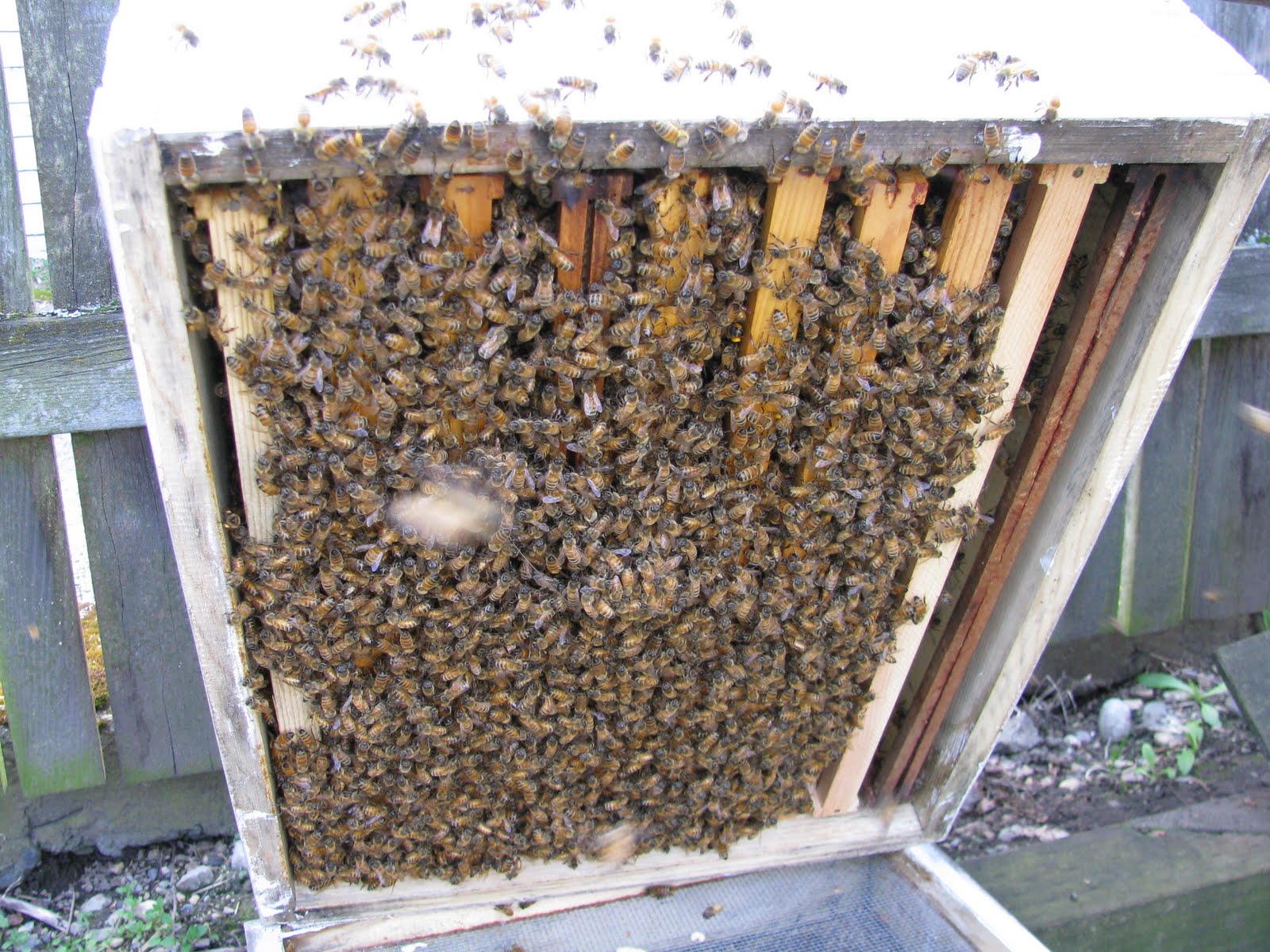
The weather is about 55 degrees F and the wind is blowing. There are thundershowers moving through the area. The bees decided to swarm. You can see in the pictures above that the bees came out of the hive and clustered on the front of the hive. I think the queen ended up under the bottom board with a lot of the swarm. We took the hive apart and banged the bottom board on top of an empty hive knocking the cluster of bees onto the frames. It was a really small swarm by the time we got the bees into the new hive. I blocked most of the entrance of the new hive with a board leaving only about 1/2 inch open for an exit. I also put a feeder with sugar water on the hive. What were those bees thinking?
Friday, March 26, 2010
Bee Log #19: March 26, 2010


Swarm. Swarm. In March!!!
A swarm is a bee hive's way of making new bee hives. The old queen leaves the hive with about half of the bees. The group forms into a ball of bees on a tree or bush or something and scouts look for a place to move into. If a beekeeper can catch this bunch of bees, they can be moved into a bee hive and will probably set up housekeeping.
I looked into the back yard at about noon on the 24th of March which was a beautiful sunny day with a temperature of about 70 degrees F and saw a cloud of bees. I went out into the bee-storm to try to see where they were headed. They circled around. Some landed here and some there. I was praying for a nice low branch so we could catch this swarm. The bees unaccountably decided to go back in the hive. We had that experience last year when a swarm of bees went back into their hive. It is like a practice swarm. A rehearsal for the real thing that will take place shortly.
We got into the hive and found it bursting with bees (see photos). Burgeoning with bees. We decided to split the hive putting frames with queen cells in each hive. We looked and looked for the queen but could not find her. One of the two hives created has a queen and one does not. Both have frames of brood and lots of worker bees and stores of food. Both have room to expand.
A split like this is a messy operation. It really messes up the bees and now one hive has no queen. There are the queen cells that are developing and a new queen will hatch. But,when a newly hatched queen is ready to mate, there needs to be a day when the weather is about 70 degrees and not too windy so she can get to the place where the drones hang out (drone congregation area). I think we need to consider buying a queen and requeening the queenless hive. Otherwise, we may be stuck with a hive that is not queenright.
The weather has gone back to rainy and chilly. I had better order that queen. Imagine ordering a queen!
Subscribe to:
Posts (Atom)


